Gibbs distribution
Ref 1 Eq. 3.37:
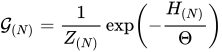
where is the number of particles, is the Hamiltonian of the system and Failed to parse (SVG (MathML can be enabled via browser plugin): Invalid response ("Math extension cannot connect to Restbase.") from server "https://wikimedia.org/api/rest_v1/":): {\displaystyle \Theta} is the temperature (to convert Failed to parse (SVG (MathML can be enabled via browser plugin): Invalid response ("Math extension cannot connect to Restbase.") from server "https://wikimedia.org/api/rest_v1/":): {\displaystyle \Theta} into the more familiar Kelvin scale one divides by the Boltzmann constant Failed to parse (SVG (MathML can be enabled via browser plugin): Invalid response ("Math extension cannot connect to Restbase.") from server "https://wikimedia.org/api/rest_v1/":): {\displaystyle k_B} ). The constant Failed to parse (SVG (MathML can be enabled via browser plugin): Invalid response ("Math extension cannot connect to Restbase.") from server "https://wikimedia.org/api/rest_v1/":): {\displaystyle Z_{(N)}} is found from the normalization condition (Ref. 1 Eq. 3.38)


- Failed to parse (Conversion error. Server ("https://wikimedia.org/api/rest_") reported: "Cannot get mml. Server problem."): {\displaystyle {\frac {1}{\Gamma _{(N)}^{(0)}Z_{(N)}}}\int _{V}\exp \left(-{\frac {U_{1},...,_{N}}{\Theta }}\right)~{\rm {d}}^{3}r_{1}...{\rm {d}}^{3}r_{N}\int _{-\infty }^{\infty }\exp \left(-{\frac {K_{(N)}}{\Theta }}\right)~{\rm {d}}^{3}p_{1}...{\rm {d}}^{3}p_{N}=1}
which leads to (Ref. 1 Eq. 3.40)
- Failed to parse (SVG (MathML can be enabled via browser plugin): Invalid response ("Math extension cannot connect to Restbase.") from server "https://wikimedia.org/api/rest_v1/":): {\displaystyle Z_{(N)}= \frac{1}{V^N} Q_{(N)}}
where (Ref. 1 Eq. 3.41)
- Failed to parse (SVG (MathML can be enabled via browser plugin): Invalid response ("Math extension cannot connect to Restbase.") from server "https://wikimedia.org/api/rest_v1/":): {\displaystyle Q_{(N)} = \int_V \exp \left( - \frac{U_1,..., _N}{\Theta}\right) ~{\rm d}^3r_1 ... {\rm d}^3r_N}
this is the statistical integral
- Failed to parse (SVG (MathML can be enabled via browser plugin): Invalid response ("Math extension cannot connect to Restbase.") from server "https://wikimedia.org/api/rest_v1/":): {\displaystyle Z \equiv \sum_n e^{-E_n/T}= {\rm tr} ~ e^{-H|T}}
where Failed to parse (SVG (MathML can be enabled via browser plugin): Invalid response ("Math extension cannot connect to Restbase.") from server "https://wikimedia.org/api/rest_v1/":): {\displaystyle H} is the Hamiltonian of the system.
References
- G. A. Martynov "Fundamental Theory of Liquids. Method of Distribution Functions", Adam Hilger (out of print)