Logarithmic oscillator thermostat: Difference between revisions
Carl McBride (talk | contribs) No edit summary |
|||
| Line 28: | Line 28: | ||
<ref>[http://dx.doi.org/10.1103/PhysRevLett.110.028902 Michele Campisi, Fei Zhan, Peter Talkner, and Peter Hänggi "Campisi et al. Reply", Physical Review Letters '''110''' 028902 (2013)]</ref> | <ref>[http://dx.doi.org/10.1103/PhysRevLett.110.028902 Michele Campisi, Fei Zhan, Peter Talkner, and Peter Hänggi "Campisi et al. Reply", Physical Review Letters '''110''' 028902 (2013)]</ref> | ||
<ref>[http://dx.doi.org/10.1103/PhysRevE.89.021301 Daniel Sponseller and Estela Blaisten-Barojas "Failure of logarithmic oscillators to serve as a thermostat for small atomic clusters", Physical Review E '''89''' 021301(R) (2014)]</ref> | <ref>[http://dx.doi.org/10.1103/PhysRevE.89.021301 Daniel Sponseller and Estela Blaisten-Barojas "Failure of logarithmic oscillators to serve as a thermostat for small atomic clusters", Physical Review E '''89''' 021301(R) (2014)]</ref> | ||
<ref>[https://dx.doi.org/10.1038%2Fs41598-017-03694-w "Violation of the virial theorem and generalized equipartition theorem for logarithmic oscillators serving as a thermostat", Scientific Reports 7, Article number: 3460]</ref> | |||
==References== | ==References== | ||
<references/> | <references/> | ||
Revision as of 13:21, 11 July 2017
The Logarithmic oscillator [1] in one dimension is given by (Eq. 2):
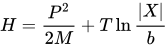
where is the position of the logarithmic oscillator, Failed to parse (SVG (MathML can be enabled via browser plugin): Invalid response ("Math extension cannot connect to Restbase.") from server "https://wikimedia.org/api/rest_v1/":): {\displaystyle P} is its linear momentum, and Failed to parse (SVG (MathML can be enabled via browser plugin): Invalid response ("Math extension cannot connect to Restbase.") from server "https://wikimedia.org/api/rest_v1/":): {\displaystyle M} represents its mass. Failed to parse (SVG (MathML can be enabled via browser plugin): Invalid response ("Math extension cannot connect to Restbase.") from server "https://wikimedia.org/api/rest_v1/":): {\displaystyle T} is the desired temperature of the thermostat, and Failed to parse (SVG (MathML can be enabled via browser plugin): Invalid response ("Math extension cannot connect to Restbase.") from server "https://wikimedia.org/api/rest_v1/":): {\displaystyle b > 0} sets a length-scale.

As a thermostat
From the Virial theorem
- Failed to parse (SVG (MathML can be enabled via browser plugin): Invalid response ("Math extension cannot connect to Restbase.") from server "https://wikimedia.org/api/rest_v1/":): {\displaystyle \left\langle X\frac{\partial H}{\partial X} \right\rangle = \left\langle P\frac{\partial H}{\partial P} \right\rangle }
one obtains
- Failed to parse (SVG (MathML can be enabled via browser plugin): Invalid response ("Math extension cannot connect to Restbase.") from server "https://wikimedia.org/api/rest_v1/":): {\displaystyle T = \left\langle \frac{P^2}{M} \right\rangle } .
This implies that all expectation values of the trajectories correspond to the very same temperature of the thermostat, irrespective of the internal energy. In other words,
- Failed to parse (SVG (MathML can be enabled via browser plugin): Invalid response ("Math extension cannot connect to Restbase.") from server "https://wikimedia.org/api/rest_v1/":): {\displaystyle \frac{\partial T}{\partial U} = 0}
this implies that the heat capacity becomes
- Failed to parse (SVG (MathML can be enabled via browser plugin): Invalid response ("Math extension cannot connect to Restbase.") from server "https://wikimedia.org/api/rest_v1/":): {\displaystyle C_V := \left. \frac{\partial U}{\partial T} \right\vert_V = \infty }
Having an infinite heat capacity is an ideal feature for a thermostat.
Practical applicability
References
- ↑ Michele Campisi, Fei Zhan, Peter Talkner, and Peter Hänggi "Logarithmic Oscillators: Ideal Hamiltonian Thermostats", Physical Review Letters 108 250601 (2012)
- ↑ Marc Meléndez Schofield "On the logarithmic oscillator as a thermostat", arXiv:1205.3478v1 (cond-mat.stat-mech) 15 May (2012)
- ↑ Marc Meléndez, Wm. G. Hoover, and Pep Español "Comment on “Logarithmic Oscillators: Ideal Hamiltonian Thermostats”", Physical Review Letters 110 028901 (2013)
- ↑ Michele Campisi, Fei Zhan, Peter Talkner, and Peter Hänggi "Campisi et al. Reply", Physical Review Letters 110 028902 (2013)
- ↑ Daniel Sponseller and Estela Blaisten-Barojas "Failure of logarithmic oscillators to serve as a thermostat for small atomic clusters", Physical Review E 89 021301(R) (2014)
- ↑ "Violation of the virial theorem and generalized equipartition theorem for logarithmic oscillators serving as a thermostat", Scientific Reports 7, Article number: 3460
- Related reading