Heat capacity: Difference between revisions
Carl McBride (talk | contribs) m (Added mention of the Adiabatic index) |
Carl McBride (talk | contribs) m (→Liquids: tmp save) |
||
| Line 37: | Line 37: | ||
For many-body distribution functions things become more complicated <ref>[http://dx.doi.org/10.1063/1.468220 Ben C. Freasier, Adam Czezowski, and Richard J. Bearman "Multibody distribution function contributions to the heat capacity for the truncated Lennard‐Jones fluid", Journal of Chemical Physics '''101''' pp. 7934-7938 (1994)]</ref>. | For many-body distribution functions things become more complicated <ref>[http://dx.doi.org/10.1063/1.468220 Ben C. Freasier, Adam Czezowski, and Richard J. Bearman "Multibody distribution function contributions to the heat capacity for the truncated Lennard‐Jones fluid", Journal of Chemical Physics '''101''' pp. 7934-7938 (1994)]</ref>. | ||
==Liquids== | ==Liquids== | ||
<ref>[http://dx.doi.org/10.1063/1.1667469 Claudio A. Cerdeiriña, Diego González-Salgado, Luis Romani, María del Carmen Delgado, Luis A. Torres and Miguel Costas "Towards an understanding of the heat capacity of liquids. A simple two-state model for molecular association", Journal of Chemical Physics '''120''' pp. 6648-6659 (2004)]</ref> | The calculation of the heat capacity in liquids is more difficult than in gasses or solids <ref>[http://dx.doi.org/10.1063/1.1667469 Claudio A. Cerdeiriña, Diego González-Salgado, Luis Romani, María del Carmen Delgado, Luis A. Torres and Miguel Costas "Towards an understanding of the heat capacity of liquids. A simple two-state model for molecular association", Journal of Chemical Physics '''120''' pp. 6648-6659 (2004)]</ref>. | ||
Recently an expression for the energy of a liquid has been developed, taking into account... (Eq. 5 of <ref>[http://dx.doi.org/10.1038/srep00421 D. Bolmatov, V. V. Brazhkin and K. Trachenko "The phonon theory of liquid thermodynamics", Scientific Reports '''2''' Article number: 421 (2012)]</ref>): | |||
:<math>E = NT \left( 1 + \frac{\alpha T}{2}\right) \left( 3D \left( \frac{\hbar \omega_D}{T} \right) -\left( \frac{\omega_F}{\omega_D} \right)^3 D\left( \frac{\hbar \omega_F}{T}\right) \right)</math> | |||
from which | |||
==Solids== | ==Solids== | ||
====Petit and Dulong==== | ====Petit and Dulong==== | ||
Revision as of 16:54, 15 June 2012
The heat capacity is defined as the differential of heat with respect to the temperature ,

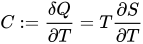
where is heat and is the entropy.


At constant volume
From the first law of thermodynamics one has

thus at constant volume, denoted by the subscript , then ,


- Failed to parse (SVG (MathML can be enabled via browser plugin): Invalid response ("Math extension cannot connect to Restbase.") from server "https://wikimedia.org/api/rest_v1/":): {\displaystyle C_V := \left.\frac{\delta Q}{\partial T} \right\vert_V = \left. \frac{\partial U}{\partial T} \right\vert_V }
At constant pressure
At constant pressure (denoted by the subscript Failed to parse (SVG (MathML can be enabled via browser plugin): Invalid response ("Math extension cannot connect to Restbase.") from server "https://wikimedia.org/api/rest_v1/":): {\displaystyle p} ),
- Failed to parse (SVG (MathML can be enabled via browser plugin): Invalid response ("Math extension cannot connect to Restbase.") from server "https://wikimedia.org/api/rest_v1/":): {\displaystyle C_p := \left.\frac{\delta Q}{\partial T} \right\vert_p =\left.\frac{\partial H}{\partial T} \right\vert_p= \left. \frac{\partial U}{\partial T} \right\vert_p + p \left.\frac{\partial V}{\partial T} \right\vert_p}
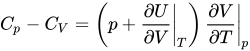
where Failed to parse (SVG (MathML can be enabled via browser plugin): Invalid response ("Math extension cannot connect to Restbase.") from server "https://wikimedia.org/api/rest_v1/":): {\displaystyle H} is the enthalpy. The difference between the heat capacity at constant pressure and the heat capacity at constant volume is given by
Adiabatic index
Sometimes the ratio of heat capacities is known as the adiabatic index:
- Failed to parse (SVG (MathML can be enabled via browser plugin): Invalid response ("Math extension cannot connect to Restbase.") from server "https://wikimedia.org/api/rest_v1/":): {\displaystyle \gamma = \frac{C_p}{C_V}}
Excess heat capacity
In a classical system the excess heat capacity for a monatomic fluid is given by subtracting the ideal internal energy (which is kinetic in nature)
- Failed to parse (SVG (MathML can be enabled via browser plugin): Invalid response ("Math extension cannot connect to Restbase.") from server "https://wikimedia.org/api/rest_v1/":): {\displaystyle C_v^{ex} = C_v - \frac{3}{2}Nk_BT}
in other words the excess heat capacity is associated with the component of the internal energy due to the intermolecular potential, and for that reason it is also known as the configurational heat capacity. Given that the excess internal energy for a pair potential is given by (Eq. 2.5.20 in [1]):
- Failed to parse (SVG (MathML can be enabled via browser plugin): Invalid response ("Math extension cannot connect to Restbase.") from server "https://wikimedia.org/api/rest_v1/":): {\displaystyle U^{ex} = 2\pi N \rho \int_0^{\infty} \Phi_{12}(r) g(r) r^2 ~{\rm d}{\mathbf r}}
where Failed to parse (SVG (MathML can be enabled via browser plugin): Invalid response ("Math extension cannot connect to Restbase.") from server "https://wikimedia.org/api/rest_v1/":): {\displaystyle \Phi_{12}(r)} is the intermolecular pair potential and Failed to parse (SVG (MathML can be enabled via browser plugin): Invalid response ("Math extension cannot connect to Restbase.") from server "https://wikimedia.org/api/rest_v1/":): {\displaystyle g(r)} is the radial distribution function, one has
- Failed to parse (SVG (MathML can be enabled via browser plugin): Invalid response ("Math extension cannot connect to Restbase.") from server "https://wikimedia.org/api/rest_v1/":): {\displaystyle C_v^{ex} = 2\pi N \rho \int_0^{\infty} \Phi_{12}(r) \left. \frac{\partial g(r)}{\partial T} \right\vert_V r^2 ~{\rm d}{\mathbf r} }
For many-body distribution functions things become more complicated [2].
Liquids
The calculation of the heat capacity in liquids is more difficult than in gasses or solids [3]. Recently an expression for the energy of a liquid has been developed, taking into account... (Eq. 5 of [4]):
- Failed to parse (SVG (MathML can be enabled via browser plugin): Invalid response ("Math extension cannot connect to Restbase.") from server "https://wikimedia.org/api/rest_v1/":): {\displaystyle E = NT \left( 1 + \frac{\alpha T}{2}\right) \left( 3D \left( \frac{\hbar \omega_D}{T} \right) -\left( \frac{\omega_F}{\omega_D} \right)^3 D\left( \frac{\hbar \omega_F}{T}\right) \right)}
from which
Solids
Petit and Dulong
Einstein
Debye
A low temperatures on has
- Failed to parse (SVG (MathML can be enabled via browser plugin): Invalid response ("Math extension cannot connect to Restbase.") from server "https://wikimedia.org/api/rest_v1/":): {\displaystyle c_v = \frac{12 \pi^4}{5} n k_B \left( \frac{T}{\Theta_D} \right)^3}
where Failed to parse (SVG (MathML can be enabled via browser plugin): Invalid response ("Math extension cannot connect to Restbase.") from server "https://wikimedia.org/api/rest_v1/":): {\displaystyle k_B} is the Boltzmann constant, Failed to parse (SVG (MathML can be enabled via browser plugin): Invalid response ("Math extension cannot connect to Restbase.") from server "https://wikimedia.org/api/rest_v1/":): {\displaystyle T} is the temperature and Failed to parse (SVG (MathML can be enabled via browser plugin): Invalid response ("Math extension cannot connect to Restbase.") from server "https://wikimedia.org/api/rest_v1/":): {\displaystyle \Theta_D} is an empirical parameter known as the Debye temperature.
See also
References
- ↑ J-P. Hansen and I. R. McDonald "Theory of Simple Liquids", Academic Press (2006) (Third Edition) ISBN 0-12-370535-5
- ↑ Ben C. Freasier, Adam Czezowski, and Richard J. Bearman "Multibody distribution function contributions to the heat capacity for the truncated Lennard‐Jones fluid", Journal of Chemical Physics 101 pp. 7934-7938 (1994)
- ↑ Claudio A. Cerdeiriña, Diego González-Salgado, Luis Romani, María del Carmen Delgado, Luis A. Torres and Miguel Costas "Towards an understanding of the heat capacity of liquids. A simple two-state model for molecular association", Journal of Chemical Physics 120 pp. 6648-6659 (2004)
- ↑ D. Bolmatov, V. V. Brazhkin and K. Trachenko "The phonon theory of liquid thermodynamics", Scientific Reports 2 Article number: 421 (2012)
- ↑ Alexis-Thérèse Petit and Pierre-Louis Dulong "Recherches sur quelques points importants de la Théorie de la Chaleur", Annales de Chimie et de Physique 10 pp. 395-413 (1819)