Clausius equation of state: Difference between revisions
Jump to navigation
Jump to search
Carl McBride (talk | contribs) (Corrected a b and c) |
Carl McBride (talk | contribs) m (Removed mention of Eq. 4 of Shah and Thodos: a b anc c are mixed up.) |
||
| Line 1: | Line 1: | ||
The '''Clausius''' [[Equations of state | equation of state]], proposed in 1880 by [[Rudolf Julius Emanuel Clausius]] <ref>[http://dx.doi.org/10.1002/andp.18802450302 R. Clausius "Über das Verhalten der Kohlensäure in Bezug auf Druck, Volumen und Temperatur", Annalen der Physik und Chemie '''9''' pp. 337-357 (1880)]</ref> is given by ( | The '''Clausius''' [[Equations of state | equation of state]], proposed in 1880 by [[Rudolf Julius Emanuel Clausius]] <ref>[http://dx.doi.org/10.1002/andp.18802450302 R. Clausius "Über das Verhalten der Kohlensäure in Bezug auf Druck, Volumen und Temperatur", Annalen der Physik und Chemie '''9''' pp. 337-357 (1880)]</ref> is given by (Eq. 3 <ref>[http://dx.doi.org/10.1021/ie50663a005 K. K. Shah and G. Thodos "A Comparison of Equations of State", Industrial & Engineering Chemistry '''57''' pp. 30-37 (1965)]</ref>) | ||
:<math>\left[ p + \frac{a}{T(v+c)^2}\right] (v-b) =RT.</math> | :<math>\left[ p + \frac{a}{T(v+c)^2}\right] (v-b) =RT.</math> | ||
Revision as of 13:26, 20 November 2009
The Clausius equation of state, proposed in 1880 by Rudolf Julius Emanuel Clausius [1] is given by (Eq. 3 [2])
=RT.}](https://wikimedia.org/api/rest_v1/media/math/render/svg/3f02e21ed2347a97172552cb26efb9eeb9920888)
where is the pressure, is the temperature, is the volume per mol, and is the molar gas constant. is the critical temperature and is the pressure at the critical point, and is the critical volume per mol.


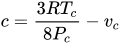
At the critical point one has , and , which leads to
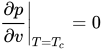
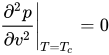
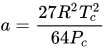
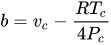
and
For details see the Mathematica printout produced by Dr. John L. Hardwick.