Universality classes: Difference between revisions
Carl McBride (talk | contribs) (→XY: Added the 3D XY model critical exponents) |
Carl McBride (talk | contribs) (Added more data to the table) |
||
| Line 1: | Line 1: | ||
'''Universality classes''' are groups of [[Idealised models | models]] that have the same set of [[critical exponents]] | |||
{| border="1" | |||
:{| border="1" | |||
|- | |- | ||
| <math> | | dimension ||<math>\alpha</math> || <math>\beta</math> || <math>\gamma</math> || <math>\delta</math> ||<math>\nu</math> || <math>\eta</math> || class | ||
|- | |- | ||
| || || | | || || || || || || || 3-state Potts | ||
|- | |- | ||
| || || | | || || || || || || ||Ashkin-Teller | ||
|- | |- | ||
| || | | || || || || || || ||Chiral | ||
|- | |- | ||
| || || | | || || || || || || ||Directed percolation | ||
|- | |- | ||
| | | 2 || 0 || <math>1/8</math> || <math>7/4</math> || || 1 || 1/4 || 2D Ising | ||
|- | |- | ||
| | | 3 || 0.1096(5) || 0.32653(10) || 1.2373(2) || 4.7893(8) || 0.63012(16) || 0.03639(15) || 3D Ising | ||
|- | |- | ||
| || | | || || || || || || ||Local linear interface | ||
|- | |- | ||
| | | || 0 || <math>1/2</math> || 1 || || || || Mean-field | ||
|- | |- | ||
| || | | || || || || || || ||Molecular beam epitaxy | ||
|- | |- | ||
| || || || | | || || || || || || ||Random-field | ||
|- | |- | ||
| || || || || | | 3 || −0.0146(8) || 0.3485(2) || 1.3177(5) || 4.780(2) ||0.67155(27) || 0.0380(4) || XY | ||
|} | |} | ||
where | |||
*<math>\alpha</math> is known as the [[Critical exponents#Heat capacity exponent| heat capacity exponent]] | |||
*<math>\beta</math> is known as the [[Critical exponents#Magnetic order parameter exponent | magnetic order parameter exponent]] | |||
*<math>\gamma</math> is known as the [[Critical exponents#Susceptibility exponent |susceptibility exponent ]] | |||
*<math>\nu</math> is known as the [[Critical exponents#Correlation length | correlation length]] | |||
*<math>\eta</math> is known as... | |||
==3-state Potts== | ==3-state Potts== | ||
==Ashkin-Teller== | ==Ashkin-Teller== | ||
| Line 64: | Line 73: | ||
\delta=15 | \delta=15 | ||
</math> | </math> | ||
along with <ref>[http://dx.doi.org/10.1103/PhysRev.180.594 Michael E. Fisher "Rigorous Inequalities for Critical-Point Correlation Exponents", Physical Review '''180''' pp. 594-600 (1969)]</ref>: | |||
:<math> | |||
\nu=1 | |||
</math> | |||
:<math> | |||
\eta = 1/4 | |||
</math> | |||
In three dimensions, the critical exponents are not known exactly. However, [[Monte Carlo | Monte Carlo simulations]] and [[Renormalisation group]] analysis provide accurate estimates <ref name="Campostrini2002">[http://dx.doi.org/10.1103/PhysRevE.65.066127 Massimo Campostrini, Andrea Pelissetto, Paolo Rossi, and Ettore Vicari "25th-order high-temperature expansion results for three-dimensional Ising-like systems on the simple-cubic lattice", Physical Review E '''65''' 066127 (2002)]</ref>: | In three dimensions, the critical exponents are not known exactly. However, [[Monte Carlo | Monte Carlo simulations]] and [[Renormalisation group]] analysis provide accurate estimates <ref name="Campostrini2002">[http://dx.doi.org/10.1103/PhysRevE.65.066127 Massimo Campostrini, Andrea Pelissetto, Paolo Rossi, and Ettore Vicari "25th-order high-temperature expansion results for three-dimensional Ising-like systems on the simple-cubic lattice", Physical Review E '''65''' 066127 (2002)]</ref>: | ||
| Line 102: | Line 122: | ||
====Susceptibility exponent: <math>\gamma</math>==== | ====Susceptibility exponent: <math>\gamma</math>==== | ||
(final result: <math>\gamma=1</math>) | (final result: <math>\gamma=1</math>) | ||
==Molecular beam epitaxy== | ==Molecular beam epitaxy== | ||
==Random-field== | ==Random-field== | ||
Revision as of 13:17, 26 July 2011
Universality classes are groups of models that have the same set of critical exponents
dimension class 3-state Potts Ashkin-Teller Chiral Directed percolation 2 0 1 1/4 2D Ising 3 0.1096(5) 0.32653(10) 1.2373(2) 4.7893(8) 0.63012(16) 0.03639(15) 3D Ising Local linear interface 0 1 Mean-field Molecular beam epitaxy Random-field 3 −0.0146(8) 0.3485(2) 1.3177(5) 4.780(2) 0.67155(27) 0.0380(4) XY


where
- is known as the heat capacity exponent
- is known as the magnetic order parameter exponent
- is known as the susceptibility exponent
- is known as the correlation length
- is known as...
3-state Potts
Ashkin-Teller
Chiral
Directed percolation
Ising
The Hamiltonian of the Ising model is
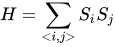
where and the summation runs over the lattice sites.

The order parameter is

In two dimensions, Onsager obtained the exact solution in the absence of a external field, and the critical exponents are

(In fact, the specific heat diverges logarithmically with the critical temperature)


along with [1]:

- Failed to parse (SVG (MathML can be enabled via browser plugin): Invalid response ("Math extension cannot connect to Restbase.") from server "https://wikimedia.org/api/rest_v1/":): {\displaystyle \eta = 1/4 }
In three dimensions, the critical exponents are not known exactly. However, Monte Carlo simulations and Renormalisation group analysis provide accurate estimates [2]:
- Failed to parse (SVG (MathML can be enabled via browser plugin): Invalid response ("Math extension cannot connect to Restbase.") from server "https://wikimedia.org/api/rest_v1/":): {\displaystyle \nu=0.63012(16) }
- Failed to parse (SVG (MathML can be enabled via browser plugin): Invalid response ("Math extension cannot connect to Restbase.") from server "https://wikimedia.org/api/rest_v1/":): {\displaystyle \alpha=0.1096(5) }
- Failed to parse (SVG (MathML can be enabled via browser plugin): Invalid response ("Math extension cannot connect to Restbase.") from server "https://wikimedia.org/api/rest_v1/":): {\displaystyle \beta= 0.32653(10) }
- Failed to parse (SVG (MathML can be enabled via browser plugin): Invalid response ("Math extension cannot connect to Restbase.") from server "https://wikimedia.org/api/rest_v1/":): {\displaystyle \gamma=1.2373(2) }
- Failed to parse (SVG (MathML can be enabled via browser plugin): Invalid response ("Math extension cannot connect to Restbase.") from server "https://wikimedia.org/api/rest_v1/":): {\displaystyle \delta=4.7893(8) }
- Failed to parse (SVG (MathML can be enabled via browser plugin): Invalid response ("Math extension cannot connect to Restbase.") from server "https://wikimedia.org/api/rest_v1/":): {\displaystyle \eta =0.03639(15) }
with a critical temperature of Failed to parse (SVG (MathML can be enabled via browser plugin): Invalid response ("Math extension cannot connect to Restbase.") from server "https://wikimedia.org/api/rest_v1/":): {\displaystyle k_BT_c = 4.51152786~S } [3]. In four and higher dimensions, the critical exponents are mean-field with logarithmic corrections.
Local linear interface
Mean-field
The critical exponents of are derived as follows [4]:
Heat capacity exponent: Failed to parse (SVG (MathML can be enabled via browser plugin): Invalid response ("Math extension cannot connect to Restbase.") from server "https://wikimedia.org/api/rest_v1/":): {\displaystyle \alpha}
(final result: Failed to parse (SVG (MathML can be enabled via browser plugin): Invalid response ("Math extension cannot connect to Restbase.") from server "https://wikimedia.org/api/rest_v1/":): {\displaystyle \alpha=0} )
Magnetic order parameter exponent: Failed to parse (SVG (MathML can be enabled via browser plugin): Invalid response ("Math extension cannot connect to Restbase.") from server "https://wikimedia.org/api/rest_v1/":): {\displaystyle \beta}
(final result: Failed to parse (SVG (MathML can be enabled via browser plugin): Invalid response ("Math extension cannot connect to Restbase.") from server "https://wikimedia.org/api/rest_v1/":): {\displaystyle \beta=1/2} )
Susceptibility exponent: Failed to parse (SVG (MathML can be enabled via browser plugin): Invalid response ("Math extension cannot connect to Restbase.") from server "https://wikimedia.org/api/rest_v1/":): {\displaystyle \gamma}
(final result: Failed to parse (SVG (MathML can be enabled via browser plugin): Invalid response ("Math extension cannot connect to Restbase.") from server "https://wikimedia.org/api/rest_v1/":): {\displaystyle \gamma=1} )
Molecular beam epitaxy
Random-field
XY
For the three dimensional XY model one has the following critical exponents[5]:
- Failed to parse (SVG (MathML can be enabled via browser plugin): Invalid response ("Math extension cannot connect to Restbase.") from server "https://wikimedia.org/api/rest_v1/":): {\displaystyle \nu=0.67155(27) }
- Failed to parse (SVG (MathML can be enabled via browser plugin): Invalid response ("Math extension cannot connect to Restbase.") from server "https://wikimedia.org/api/rest_v1/":): {\displaystyle \alpha = -0.0146(8)}
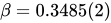
- Failed to parse (SVG (MathML can be enabled via browser plugin): Invalid response ("Math extension cannot connect to Restbase.") from server "https://wikimedia.org/api/rest_v1/":): {\displaystyle \gamma=1.3177(5) }
- Failed to parse (SVG (MathML can be enabled via browser plugin): Invalid response ("Math extension cannot connect to Restbase.") from server "https://wikimedia.org/api/rest_v1/":): {\displaystyle \delta=4.780(2) }
- Failed to parse (SVG (MathML can be enabled via browser plugin): Invalid response ("Math extension cannot connect to Restbase.") from server "https://wikimedia.org/api/rest_v1/":): {\displaystyle \eta =0.0380(4) }
References
- ↑ Michael E. Fisher "Rigorous Inequalities for Critical-Point Correlation Exponents", Physical Review 180 pp. 594-600 (1969)
- ↑ Massimo Campostrini, Andrea Pelissetto, Paolo Rossi, and Ettore Vicari "25th-order high-temperature expansion results for three-dimensional Ising-like systems on the simple-cubic lattice", Physical Review E 65 066127 (2002)
- ↑ A. L. Talapov and H. W. J Blöte "The magnetization of the 3D Ising model", Journal of Physics A: Mathematical and General 29 pp. 5727-5733 (1996)
- ↑ Linda E. Reichl "A Modern Course in Statistical Physics", Wiley-VCH, Berlin 3rd Edition (2009) ISBN 3-527-40782-0 § 4.9.4
- ↑ Massimo Campostrini, Martin Hasenbusch, Andrea Pelissetto, Paolo Rossi, and Ettore Vicari "Critical behavior of the three-dimensional XY universality class" Physical Review B 63 214503 (2001)