Legendre polynomials: Difference between revisions
Jump to navigation
Jump to search
m (orthogonality definitions) |
Carl McBride (talk | contribs) m (Added applications section.) |
||
| (5 intermediate revisions by 2 users not shown) | |||
| Line 5: | Line 5: | ||
:<math>P_n (z) = \frac{1}{2 \pi i} \oint ( 1-2tz + t^2)^{1/2}~t^{-n-1} {\rm d}t</math> | :<math>P_n (z) = \frac{1}{2 \pi i} \oint ( 1-2tz + t^2)^{1/2}~t^{-n-1} {\rm d}t</math> | ||
Legendre polynomials can also be defined (Ref 1) using Rodrigues formula, used for producing a series of orthogonal polynomials, as: | |||
:<math> P_n(x) = \frac{1}{2^n n!} \frac{d^n}{dx^n} (x^2 - 1)^n </math> | :<math> P_n(x) = \frac{1}{2^n n!} \frac{d^n}{dx^n} (x^2 - 1)^n </math> | ||
| Line 12: | Line 12: | ||
:<math> \int_{-1}^{1} P_n(x) P_m(x) d x = 0, </math> for <math> m \ne n </math> | :<math> \int_{-1}^{1} P_n(x) P_m(x) d x = 0, </math> for <math> m \ne n </math> | ||
whereas | |||
:<math>\int_{-1}^{1} P_n(x) P_n(x) d x = \frac{2}{2n+1} </math> | |||
The first seven Legendre polynomials are: | The first seven Legendre polynomials are: | ||
| Line 35: | Line 39: | ||
:<math>P_6 (x) =\frac{1}{16}(231x^6 -315x^4 + 105x^2 -5)</math> | :<math>P_6 (x) =\frac{1}{16}(231x^6 -315x^4 + 105x^2 -5)</math> | ||
"shifted" Legendre polynomials (which obey the orthogonality relationship): | "shifted" Legendre polynomials (which obey the orthogonality relationship | ||
in the range [0:1]): | |||
:<math>\overline{P}_0 (x) =1</math> | :<math>\overline{P}_0 (x) =1</math> | ||
| Line 66: | Line 71: | ||
:<math>x^6= \frac{1}{231}[33P_0 (x) + 110P_2(x)+ 72P_4(x)+ 16P_6(x)]</math> | :<math>x^6= \frac{1}{231}[33P_0 (x) + 110P_2(x)+ 72P_4(x)+ 16P_6(x)]</math> | ||
==Applications in statistical mechanics== | |||
*[[Computational implementation of integral equations]] | |||
*[[Order parameters]] | |||
*[[Lebwohl-Lasher model]] | |||
*[[Rotational relaxation]] | |||
==See also== | ==See also== | ||
*[[Associated Legendre function]] | *[[Associated Legendre function]] | ||
*[http://mathworld.wolfram.com/LegendrePolynomial.html Legendre Polynomial -- from Wolfram MathWorld] | *[http://mathworld.wolfram.com/LegendrePolynomial.html Legendre Polynomial -- from Wolfram MathWorld] | ||
[[category: mathematics]] | [[category: mathematics]] | ||
==References== | |||
# B. P. Demidotwitsch, I. A. Maron, and E. S. Schuwalowa, "Métodos numéricos de Análisis", Ed. Paraninfo, Madrid (1980) (translated from Russian text) | |||
Latest revision as of 12:06, 7 July 2008
Legendre polynomials (also known as Legendre functions of the first kind, Legendre coefficients, or zonal harmonics) are solutions of the Legendre differential equation. The Legendre polynomial, can be defined by the contour integral


Legendre polynomials can also be defined (Ref 1) using Rodrigues formula, used for producing a series of orthogonal polynomials, as:

Legendre polynomials form an orthogonal system in the range [-1:1], i.e.:
- for
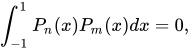

whereas
- Failed to parse (SVG (MathML can be enabled via browser plugin): Invalid response ("Math extension cannot connect to Restbase.") from server "https://wikimedia.org/api/rest_v1/":): {\displaystyle \int_{-1}^{1} P_n(x) P_n(x) d x = \frac{2}{2n+1} }
The first seven Legendre polynomials are:
- Failed to parse (SVG (MathML can be enabled via browser plugin): Invalid response ("Math extension cannot connect to Restbase.") from server "https://wikimedia.org/api/rest_v1/":): {\displaystyle \left. P_0 (x) \right.=1}
- Failed to parse (SVG (MathML can be enabled via browser plugin): Invalid response ("Math extension cannot connect to Restbase.") from server "https://wikimedia.org/api/rest_v1/":): {\displaystyle \left. P_1 (x) \right.=x}
- Failed to parse (SVG (MathML can be enabled via browser plugin): Invalid response ("Math extension cannot connect to Restbase.") from server "https://wikimedia.org/api/rest_v1/":): {\displaystyle P_2 (x) =\frac{1}{2}(3x^2-1)}
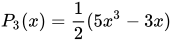
- Failed to parse (SVG (MathML can be enabled via browser plugin): Invalid response ("Math extension cannot connect to Restbase.") from server "https://wikimedia.org/api/rest_v1/":): {\displaystyle P_4 (x) =\frac{1}{8}(35x^4 - 30x^2 +3)}
- Failed to parse (SVG (MathML can be enabled via browser plugin): Invalid response ("Math extension cannot connect to Restbase.") from server "https://wikimedia.org/api/rest_v1/":): {\displaystyle P_5 (x) =\frac{1}{8}(63x^5 - 70x^3 + 15x)}
- Failed to parse (SVG (MathML can be enabled via browser plugin): Invalid response ("Math extension cannot connect to Restbase.") from server "https://wikimedia.org/api/rest_v1/":): {\displaystyle P_6 (x) =\frac{1}{16}(231x^6 -315x^4 + 105x^2 -5)}
"shifted" Legendre polynomials (which obey the orthogonality relationship in the range [0:1]):
- Failed to parse (SVG (MathML can be enabled via browser plugin): Invalid response ("Math extension cannot connect to Restbase.") from server "https://wikimedia.org/api/rest_v1/":): {\displaystyle \overline{P}_0 (x) =1}
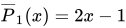
- Failed to parse (SVG (MathML can be enabled via browser plugin): Invalid response ("Math extension cannot connect to Restbase.") from server "https://wikimedia.org/api/rest_v1/":): {\displaystyle \overline{P}_2 (x) =6x^2 -6x +1}
- Failed to parse (SVG (MathML can be enabled via browser plugin): Invalid response ("Math extension cannot connect to Restbase.") from server "https://wikimedia.org/api/rest_v1/":): {\displaystyle \overline{P}_3 (x) =20x^3 - 30x^2 +12x -1}
Powers in terms of Legendre polynomials:
- Failed to parse (SVG (MathML can be enabled via browser plugin): Invalid response ("Math extension cannot connect to Restbase.") from server "https://wikimedia.org/api/rest_v1/":): {\displaystyle \left. x \right.= P_1 (x)}
- Failed to parse (SVG (MathML can be enabled via browser plugin): Invalid response ("Math extension cannot connect to Restbase.") from server "https://wikimedia.org/api/rest_v1/":): {\displaystyle x^2= \frac{1}{3}[P_0 (x) + 2P_2(x)]}
![{\displaystyle x^{3}={\frac {1}{5}}[3P_{1}(x)+2P_{3}(x)]}](https://wikimedia.org/api/rest_v1/media/math/render/svg/f95e83961b601f0a2b99d603e01a354f4897a919)
- Failed to parse (SVG (MathML can be enabled via browser plugin): Invalid response ("Math extension cannot connect to Restbase.") from server "https://wikimedia.org/api/rest_v1/":): {\displaystyle x^4= \frac{1}{35}[7P_0 (x) + 20P_2(x)+ 8P_4(x)]}
- Failed to parse (SVG (MathML can be enabled via browser plugin): Invalid response ("Math extension cannot connect to Restbase.") from server "https://wikimedia.org/api/rest_v1/":): {\displaystyle x^5= \frac{1}{63}[27P_1 (x) + 28P_3(x)+ 8P_5(x)]}
![{\displaystyle x^{6}={\frac {1}{231}}[33P_{0}(x)+110P_{2}(x)+72P_{4}(x)+16P_{6}(x)]}](https://wikimedia.org/api/rest_v1/media/math/render/svg/99acb8dfaa1450eba1cfd4b575e1982776f818a7)
Applications in statistical mechanics[edit]
- Computational implementation of integral equations
- Order parameters
- Lebwohl-Lasher model
- Rotational relaxation
See also[edit]
References[edit]
- B. P. Demidotwitsch, I. A. Maron, and E. S. Schuwalowa, "Métodos numéricos de Análisis", Ed. Paraninfo, Madrid (1980) (translated from Russian text)