Liouville's theorem

From SklogWiki
Jump to navigation Jump to search

Liouville's theorem is an expression of the conservation of volume of phase space [1]:
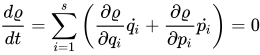
Failed to parse (SVG (MathML can be enabled via browser plugin): Invalid response ("Math extension cannot connect to Restbase.") from server "https://wikimedia.org/api/rest_v1/":): {\displaystyle \frac{d\varrho}{dt}= \sum_{i=1}^{s} \left( \frac{\partial \varrho}{\partial q_i} \dot{q_i}+ \frac{\partial \varrho}{\partial p_i} \dot{p_i} \right) =0 }

where Failed to parse (SVG (MathML can be enabled via browser plugin): Invalid response ("Math extension cannot connect to Restbase.") from server "https://wikimedia.org/api/rest_v1/":): {\displaystyle \varrho} is a distribution function Failed to parse (SVG (MathML can be enabled via browser plugin): Invalid response ("Math extension cannot connect to Restbase.") from server "https://wikimedia.org/api/rest_v1/":): {\displaystyle \varrho(p,q)} , p is the generalised momenta and q are the generalised coordinates. With time a volume element can change shape, but phase points neither enter nor leave the volume.

References[edit]