Defining the local activity by
![{\displaystyle z({\mathbf {r} })=z\exp[-\beta \psi ({\mathbf {r} })]}](https://wikimedia.org/api/rest_v1/media/math/render/svg/178520ecabed11f104892aacdfdf3e9cb7438245)
where  , and
, and  is the Boltzmann constant.
Using those definitions the grand canonical partition function can be written as
is the Boltzmann constant.
Using those definitions the grand canonical partition function can be written as
 .
.
By functionally-differentiating  with respect to
  , and utilizing the mathematical theorem concerning the functional derivative,
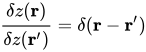 ,
,
we obtain the following equations with respect to the density pair correlation functions:
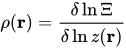 ,
,
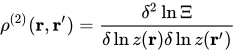 .
.
A relation between  and
and  can be obtained after some manipulation as,
 .
.
Now, we define the direct correlation function by an inverse relation of the previous equation,
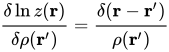 .
.
Inserting these two results into the chain-rule theorem of functional derivatives,
 ,
,
one obtains the Ornstein-Zernike relation.
Thus the Ornstein-Zernike relation is, in a sense, a differential form of the partition function.
(Note: the material in this page was adapted from a text whose authorship and copyright status are both unknown).
See also[edit]
References[edit]