Fermi-Jagla model
The Fermi-Jagla model is a smooth variant of the Jagla model. It is given by (Eq. 1 in [1]):
![{\displaystyle \Phi _{12}(r)=\epsilon _{0}\left[\left({\frac {a}{r}}\right)^{n}+{\frac {A_{0}}{1+\exp \left[{\frac {A_{1}}{A_{0}}}({\frac {r}{a}}-A_{2})\right]}}-{\frac {B_{0}}{1+\exp \left[{\frac {B_{1}}{B_{0}}}({\frac {r}{a}}-B_{2})\right]}}\right]}](https://wikimedia.org/api/rest_v1/media/math/render/svg/9e746e236c78fd9fcd2bb0ff5f1e8194cb9581a8)
There is a relation between the Fermi function and hyperbolic tangent:
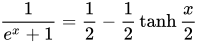
Using this relation one can show that Fermi-Jagla model is equivalent to the generalised Fomin potential (which has scientific priority).
References[edit]
- Related reading
- Shaina Reisman and Nicolas Giovambattista "Glass and liquid phase diagram of a polyamorphic monatomic system", Journal of Chemical Physics 138 064509 (2013)
- Saki Higuchi, Daiki Kato, Daisuke Awaji, and  Kang Kim "Connecting thermodynamic and dynamical anomalies of water-like liquid-liquid phase transition in the Fermi–Jagla model", Journal of Chemical Physics 148 094507 (2018)