Virial theorem

From SklogWiki
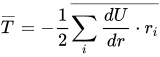
Revision as of 13:42, 26 March 2007 by Carl McBride (talk | contribs) (New page: The '''virial theorem''' is a feature of systems with central forces. :<math>\overline{T}= - \frac{1}{2} \overline{\sum_i \frac{dU}{dr}\cdot r_i}</math> where <math>\overline{T}</math> i...)
(diff) ← Older revision | Latest revision (diff) | Newer revision → (diff)
Jump to navigation Jump to search

The virial theorem is a feature of systems with central forces.

Failed to parse (SVG (MathML can be enabled via browser plugin): Invalid response ("Math extension cannot connect to Restbase.") from server "https://wikimedia.org/api/rest_v1/":): {\displaystyle \overline{T}= - \frac{1}{2} \overline{\sum_i \frac{dU}{dr}\cdot r_i}}

where Failed to parse (SVG (MathML can be enabled via browser plugin): Invalid response ("Math extension cannot connect to Restbase.") from server "https://wikimedia.org/api/rest_v1/":): {\displaystyle \overline{T}} is the kinetic energy. The overlines represent time averages. The right hand side is known as the virial of Clausius (Ref. 2).

References

  1. Section 3.4 of Classical Mechanics by Herbert Goldstein 2nd Edition (1980) Addison Wesley
  2. R. Clausius, " " Philosophical Magazine 40 pp. 122- (1870)