Mean field models
A mean field model, or a mean field solution of a model, is an approximation to the actual solution of a model in statistical physics. The model is made exactly solvable by treating the effect of all other particles on a given one as a mean field (hence its name). It appear in different forms and different contexts, but all mean field models have this feature in common.
Mean field solution of the Ising model
A well-known mean field solution of the Ising model goes as follows. From the original hamiltonian,
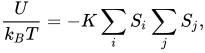
suppose we may approximate
- Failed to parse (Conversion error. Server ("https://wikimedia.org/api/rest_") reported: "Cannot get mml. Server problem."): {\displaystyle \sum _{j}S_{j}\approx N{\bar {s}},}
where is the number of neighbors of site (e.g. 4 in a 2-D squate lattice), and is the (unknown) magnetization:


- Failed to parse (Conversion error. Server ("https://wikimedia.org/api/rest_") reported: "Cannot get mml. Server problem."): {\displaystyle {\bar {s}}={\frac {1}{N}}\sum _{i}S_{i}.}