Model:
Consider a system with  spins in a row.
The energy of the system will be given by
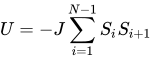 ,
,
where each variable  can be either -1 or +1.
The partition function of the system will be:
![{\displaystyle Q_{N}=\sum _{\Omega ^{N}}\exp \left[K\sum _{i=1}^{N-1}S_{i}S_{i+1}\right]}](https://wikimedia.org/api/rest_v1/media/math/render/svg/a1419d045395f90f5727c9e80f5550a0aa103109) ,
,
where  represents the possible configuration of the N spins of the system,
and
represents the possible configuration of the N spins of the system,
and 

Performing the sum of the possible values of  we get:
![{\displaystyle Q_{N+1}=\sum _{S_{1}}\sum _{S_{2}}e^{kS_{1}S_{2}}\sum _{S_{3}}e^{KS_{2}S_{3}}\cdots \sum _{S_{N}}e^{KS_{N-1}S_{N}}\left[2\cosh(KS_{N})\right]}](https://wikimedia.org/api/rest_v1/media/math/render/svg/8df5eec989565c85d35e7099b1390724d3106ef1)
Taking into account that 
![{\displaystyle Q_{N+1}=\sum _{S_{1}}\sum _{S_{2}}e^{kS_{1}S_{2}}\sum _{S_{3}}e^{KS_{2}S_{3}}\cdots \sum _{S_{N}}e^{KS_{N-1}S_{N}}\left[2\cosh(K)\right]}](https://wikimedia.org/api/rest_v1/media/math/render/svg/11f600382705ac031065c45584acbf824afa3d7a)
Therefore:


The Helmholtz free energy in the thermodynamic limit will be
