Inverse temperature: Difference between revisions
(cleaned a bit, added reference to quantum stat. mech.) |
Carl McBride (talk | contribs) m (→References: Added ISBN to book reference.) |
||
| Line 36: | Line 36: | ||
==References== | ==References== | ||
#Kerson Huang, "Statistical Physics" John Wiley and Sons, second edition (1987) | #Kerson Huang, "Statistical Physics" John Wiley and Sons, second edition (1987) ISBN 978-0-471-81518-1 | ||
[[category: Classical thermodynamics]] | [[category: Classical thermodynamics]] | ||
[[category: statistical mechanics]] | [[category: statistical mechanics]] | ||
[[category: Non-equilibrium thermodynamics]] | [[category: Non-equilibrium thermodynamics]] | ||
Revision as of 12:49, 4 March 2010
It is often convenient to define a dimensionless inverse temperature, Failed to parse (SVG (MathML can be enabled via browser plugin): Invalid response ("Math extension cannot connect to Restbase.") from server "https://wikimedia.org/api/rest_v1/":): {\displaystyle \beta} :
- Failed to parse (SVG (MathML can be enabled via browser plugin): Invalid response ("Math extension cannot connect to Restbase.") from server "https://wikimedia.org/api/rest_v1/":): {\displaystyle \beta := \frac{1}{k_BT}}
This notation likely comes from its origin as a Lagrangian multiplier, for which Greek letters are customarily written.
Indeed, it shown in Ref. 1 (pp. 79-85) that this is the way it enters. The task is to maximize number of ways $N$ particles may be asigned to $K$ space-momentum cells, such that one has a set of occupation numbers Failed to parse (SVG (MathML can be enabled via browser plugin): Invalid response ("Math extension cannot connect to Restbase.") from server "https://wikimedia.org/api/rest_v1/":): {\displaystyle n_i} . Introducing the partition function:
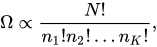
- Failed to parse (SVG (MathML can be enabled via browser plugin): Invalid response ("Math extension cannot connect to Restbase.") from server "https://wikimedia.org/api/rest_v1/":): {\displaystyle \Omega\propto\frac{N!}{n_1! n_2! \ldots n_K!} ,}
one could maximize its logarithm (a monotonous function):

- Failed to parse (SVG (MathML can be enabled via browser plugin): Invalid response ("Math extension cannot connect to Restbase.") from server "https://wikimedia.org/api/rest_v1/":): {\displaystyle \log \Omega \approx \log N -N - \sum_ i ( \log n_i + n_i) + \mathrm{consts} ,}
where Stirling's approximation for large numbers has been used. The maximization must be performed subject to the constraint:
- Failed to parse (SVG (MathML can be enabled via browser plugin): Invalid response ("Math extension cannot connect to Restbase.") from server "https://wikimedia.org/api/rest_v1/":): {\displaystyle \sum_i n_i=N}
An additional constraint, which applies only to dilute gases, is:
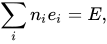
where Failed to parse (SVG (MathML can be enabled via browser plugin): Invalid response ("Math extension cannot connect to Restbase.") from server "https://wikimedia.org/api/rest_v1/":): {\displaystyle E} is the total energy and Failed to parse (SVG (MathML can be enabled via browser plugin): Invalid response ("Math extension cannot connect to Restbase.") from server "https://wikimedia.org/api/rest_v1/":): {\displaystyle e_i=p_i^2/2m} is the energy of cell Failed to parse (SVG (MathML can be enabled via browser plugin): Invalid response ("Math extension cannot connect to Restbase.") from server "https://wikimedia.org/api/rest_v1/":): {\displaystyle i} .
The method of Lagrange multipliers entails finding the extremum of the function

- Failed to parse (SVG (MathML can be enabled via browser plugin): Invalid response ("Math extension cannot connect to Restbase.") from server "https://wikimedia.org/api/rest_v1/":): {\displaystyle L=\log\Omega - \alpha (\sum_i n_i - N ) - \beta ( \sum_i n_i e_i - E ),}
where the two Lagrange multipliers enforce the two conditions and permit the treatment of the occupations as independent variables. The minimization leads to
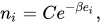
- Failed to parse (SVG (MathML can be enabled via browser plugin): Invalid response ("Math extension cannot connect to Restbase.") from server "https://wikimedia.org/api/rest_v1/":): {\displaystyle n_i=C e^{-\beta e_i}, }
and an application to the case of an ideal gas reveals the connection with the temperature,
- Failed to parse (SVG (MathML can be enabled via browser plugin): Invalid response ("Math extension cannot connect to Restbase.") from server "https://wikimedia.org/api/rest_v1/":): {\displaystyle \beta := \frac{1}{k_BT} .}
Similar methods are used for quantum statistics of dilute gases (Ref. 1, pp. 179-185).
References
- Kerson Huang, "Statistical Physics" John Wiley and Sons, second edition (1987) ISBN 978-0-471-81518-1