H-theorem: Difference between revisions
Carl McBride (talk | contribs) No edit summary |
Carl McBride (talk | contribs) No edit summary |
||
| Line 10: | Line 10: | ||
where the function C() represents binary collisions. | where the function C() represents binary collisions. | ||
At equilibrium, <math>\sigma = 0</math>. | At equilibrium, <math>\sigma = 0</math>. | ||
==H-function== | |||
Boltzmann's ''H-function'' is defined by (Eq. 5.66 Ref. 3): | |||
:<math>H=\iint f({\mathbf V}, {\mathbf r}, t) \ln f({\mathbf V}, {\mathbf r}, t) ~ d {\mathbf r} d{\mathbf V}</math> | |||
where <math>{\mathbf V}</math> is the molecular velocity. A restatement of the H-theorem is | |||
:<math>\frac{dH}{dt} \leq 0</math> | |||
==See also== | ==See also== | ||
*[[Boltzmann equation]] | *[[Boltzmann equation]] | ||
| Line 16: | Line 24: | ||
# L. Boltzmann "", Wiener Ber. '''63''' pp. 275- (1872) | # L. Boltzmann "", Wiener Ber. '''63''' pp. 275- (1872) | ||
#[http://store.doverpublications.com/0486647412.html Sybren R. De Groot and Peter Mazur "Non-Equilibrium Thermodynamics", Dover Publications] | #[http://store.doverpublications.com/0486647412.html Sybren R. De Groot and Peter Mazur "Non-Equilibrium Thermodynamics", Dover Publications] | ||
#[http://www.oup.com/uk/catalogue/?ci=9780195140187 Robert Zwanzig "Nonequilibrium Statistical Mechanics", Oxford University Press (2001)] | |||
[[category: non-equilibrium thermodynamics]] | [[category: non-equilibrium thermodynamics]] | ||
Revision as of 14:07, 24 August 2007
Boltzmann's H-theorem states that the entropy of a closed system can only increase in the course of time, and must approach a limit as time tends to infinity.
- Failed to parse (SVG (MathML can be enabled via browser plugin): Invalid response ("Math extension cannot connect to Restbase.") from server "https://wikimedia.org/api/rest_v1/":): {\displaystyle \sigma \geq 0}
where Failed to parse (SVG (MathML can be enabled via browser plugin): Invalid response ("Math extension cannot connect to Restbase.") from server "https://wikimedia.org/api/rest_v1/":): {\displaystyle \sigma} is the entropy source strength, given by (Eq 36 Chap IX Ref. 2)
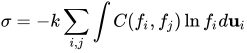
where the function C() represents binary collisions. At equilibrium, Failed to parse (SVG (MathML can be enabled via browser plugin): Invalid response ("Math extension cannot connect to Restbase.") from server "https://wikimedia.org/api/rest_v1/":): {\displaystyle \sigma = 0} .
H-function
Boltzmann's H-function is defined by (Eq. 5.66 Ref. 3):
- Failed to parse (SVG (MathML can be enabled via browser plugin): Invalid response ("Math extension cannot connect to Restbase.") from server "https://wikimedia.org/api/rest_v1/":): {\displaystyle H=\iint f({\mathbf V}, {\mathbf r}, t) \ln f({\mathbf V}, {\mathbf r}, t) ~ d {\mathbf r} d{\mathbf V}}
where Failed to parse (SVG (MathML can be enabled via browser plugin): Invalid response ("Math extension cannot connect to Restbase.") from server "https://wikimedia.org/api/rest_v1/":): {\displaystyle {\mathbf V}} is the molecular velocity. A restatement of the H-theorem is
- Failed to parse (SVG (MathML can be enabled via browser plugin): Invalid response ("Math extension cannot connect to Restbase.") from server "https://wikimedia.org/api/rest_v1/":): {\displaystyle \frac{dH}{dt} \leq 0}
See also
References
- L. Boltzmann "", Wiener Ber. 63 pp. 275- (1872)
- Sybren R. De Groot and Peter Mazur "Non-Equilibrium Thermodynamics", Dover Publications
- Robert Zwanzig "Nonequilibrium Statistical Mechanics", Oxford University Press (2001)