Mie potential: Difference between revisions
Jump to navigation
Jump to search
Carl McBride (talk | contribs) m (Removed mention of diameter) |
Carl McBride (talk | contribs) m (Added a recent publication) |
||
| Line 11: | Line 11: | ||
#[http://dx.doi.org/10.1063/1.2901164 Afshin Eskandari Nasrabad "Monte Carlo simulations of thermodynamic and structural properties of Mie(14,7) fluids", Journal of Chemical Physics '''128''' 154514 (2008)] | #[http://dx.doi.org/10.1063/1.2901164 Afshin Eskandari Nasrabad "Monte Carlo simulations of thermodynamic and structural properties of Mie(14,7) fluids", Journal of Chemical Physics '''128''' 154514 (2008)] | ||
#[http://dx.doi.org/10.1063/1.2953331 Afshin Eskandari Nasrabad, Nader Mansoori Oghaz, and Behzad Haghighi "Transport properties of Mie(14,7) fluids: Molecular dynamics simulation and theory", Journal of Chemical Physics '''129''' 024507 (2008)] | #[http://dx.doi.org/10.1063/1.2953331 Afshin Eskandari Nasrabad, Nader Mansoori Oghaz, and Behzad Haghighi "Transport properties of Mie(14,7) fluids: Molecular dynamics simulation and theory", Journal of Chemical Physics '''129''' 024507 (2008)] | ||
==Second virial coefficient== | |||
The [[second virial coefficient]] and the Vliegenthart–Lekkerkerker relation <ref>[http://dx.doi.org/10.1063/1.3578469 V. L. Kulinskii "The Vliegenthart–Lekkerkerker relation: The case of the Mie-fluids", Journal of Chemical Physics '''134''' 144111 (2011)]</ref>. | |||
==References== | ==References== | ||
<references/> | <references/> | ||
Revision as of 15:57, 14 April 2011
The Mie potential was proposed by Gustav Mie in 1903 [1]. It is given by
- Failed to parse (SVG (MathML can be enabled via browser plugin): Invalid response ("Math extension cannot connect to Restbase.") from server "https://wikimedia.org/api/rest_v1/":): {\displaystyle \Phi_{12}(r) = \left( \frac{n}{n-m}\right) \left( \frac{n}{m}\right)^{m/(n-m)} \epsilon \left[ \left(\frac{\sigma}{r} \right)^{n}- \left( \frac{\sigma}{r}\right)^m \right] }
where:
- Failed to parse (SVG (MathML can be enabled via browser plugin): Invalid response ("Math extension cannot connect to Restbase.") from server "https://wikimedia.org/api/rest_v1/":): {\displaystyle \Phi_{12}(r) } is the intermolecular pair potential between two particles at a distance r;
- Failed to parse (SVG (MathML can be enabled via browser plugin): Invalid response ("Math extension cannot connect to Restbase.") from server "https://wikimedia.org/api/rest_v1/":): {\displaystyle \sigma } is the value of Failed to parse (SVG (MathML can be enabled via browser plugin): Invalid response ("Math extension cannot connect to Restbase.") from server "https://wikimedia.org/api/rest_v1/":): {\displaystyle r} at Failed to parse (SVG (MathML can be enabled via browser plugin): Invalid response ("Math extension cannot connect to Restbase.") from server "https://wikimedia.org/api/rest_v1/":): {\displaystyle \Phi(r)=0} ;
- Failed to parse (SVG (MathML can be enabled via browser plugin): Invalid response ("Math extension cannot connect to Restbase.") from server "https://wikimedia.org/api/rest_v1/":): {\displaystyle \epsilon } : well depth (energy)
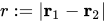
Note that when Failed to parse (SVG (MathML can be enabled via browser plugin): Invalid response ("Math extension cannot connect to Restbase.") from server "https://wikimedia.org/api/rest_v1/":): {\displaystyle n=12} and Failed to parse (SVG (MathML can be enabled via browser plugin): Invalid response ("Math extension cannot connect to Restbase.") from server "https://wikimedia.org/api/rest_v1/":): {\displaystyle m=6} this becomes the Lennard-Jones model.
(14,7) model
- Afshin Eskandari Nasrabad "Monte Carlo simulations of thermodynamic and structural properties of Mie(14,7) fluids", Journal of Chemical Physics 128 154514 (2008)
- Afshin Eskandari Nasrabad, Nader Mansoori Oghaz, and Behzad Haghighi "Transport properties of Mie(14,7) fluids: Molecular dynamics simulation and theory", Journal of Chemical Physics 129 024507 (2008)
Second virial coefficient
The second virial coefficient and the Vliegenthart–Lekkerkerker relation [2].
References
Related reading