Navier-Stokes equations: Difference between revisions
(New page with NS equations) |
(No difference)
|
Revision as of 11:54, 13 May 2010
Continuity
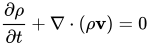
or, using the substantive derivative:
- Failed to parse (Conversion error. Server ("https://wikimedia.org/api/rest_") reported: "Cannot get mml. Server problem."): {\displaystyle {\frac {D\rho }{Dt}}+\rho (\nabla \cdot \mathbf {v} )=0.}
For an incompressible fluid, is constant, hence the velocity field must be divergence-free:

- Failed to parse (Conversion error. Server ("https://wikimedia.org/api/rest_") reported: "Cannot get mml. Server problem."): {\displaystyle \nabla \cdot \mathbf {v} =0.}
Momentum
(Also known as the Navier-Stokes equation.)
- Failed to parse (Conversion error. Server ("https://wikimedia.org/api/rest_") reported: "Cannot get mml. Server problem."): {\displaystyle \rho \left({\frac {\partial \mathbf {v} }{\partial t}}+\mathbf {v} \cdot \nabla \mathbf {v} \right)=-\nabla p+\nabla \cdot \mathbb {T} +\mathbf {f} ,}
or, using the substantive derivative:
- Failed to parse (Conversion error. Server ("https://wikimedia.org/api/rest_") reported: "Cannot get mml. Server problem."): {\displaystyle \rho \left({\frac {D\mathbf {v} }{Dt}}\right)=-\nabla p+\nabla \cdot \mathbb {T} +\mathbf {f} ,}
where is a volumetric force (e.g. Failed to parse (Conversion error. Server ("https://wikimedia.org/api/rest_") reported: "Cannot get mml. Server problem."): {\displaystyle \rho g} for gravity), and is the stress tensor.


The vector quantity Failed to parse (Conversion error. Server ("https://wikimedia.org/api/rest_") reported: "Cannot get mml. Server problem."): {\displaystyle \nabla \cdot \mathbb {T} } is the shear stress. For a Newtonian incompressible fluid,
- Failed to parse (Conversion error. Server ("https://wikimedia.org/api/rest_") reported: "Cannot get mml. Server problem."): {\displaystyle \nabla \mathbb {T} =\mu \nabla ^{2}\mathbf {v} ,}
with being the (dynamic) viscosity.

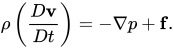
For an inviscid fluid, the momentum equation becomes Euler's equation for ideal fluids: