H-theorem: Difference between revisions
Jump to navigation
Jump to search
Carl McBride (talk | contribs) No edit summary |
Carl McBride (talk | contribs) No edit summary |
||
| Line 10: | Line 10: | ||
where the function C() represents binary collisions. | where the function C() represents binary collisions. | ||
At equilibrium, <math>\sigma = 0</math>. | At equilibrium, <math>\sigma = 0</math>. | ||
==H-function== | |||
Boltzmann's ''H-function'' is defined by (Eq. 5.66 Ref. 3): | |||
:<math>H=\iint f({\mathbf V}, {\mathbf r}, t) \ln f({\mathbf V}, {\mathbf r}, t) ~ d {\mathbf r} d{\mathbf V}</math> | |||
where <math>{\mathbf V}</math> is the molecular velocity. A restatement of the H-theorem is | |||
:<math>\frac{dH}{dt} \leq 0</math> | |||
==See also== | ==See also== | ||
*[[Boltzmann equation]] | *[[Boltzmann equation]] | ||
| Line 16: | Line 24: | ||
# L. Boltzmann "", Wiener Ber. '''63''' pp. 275- (1872) | # L. Boltzmann "", Wiener Ber. '''63''' pp. 275- (1872) | ||
#[http://store.doverpublications.com/0486647412.html Sybren R. De Groot and Peter Mazur "Non-Equilibrium Thermodynamics", Dover Publications] | #[http://store.doverpublications.com/0486647412.html Sybren R. De Groot and Peter Mazur "Non-Equilibrium Thermodynamics", Dover Publications] | ||
#[http://www.oup.com/uk/catalogue/?ci=9780195140187 Robert Zwanzig "Nonequilibrium Statistical Mechanics", Oxford University Press (2001)] | |||
[[category: non-equilibrium thermodynamics]] | [[category: non-equilibrium thermodynamics]] | ||
Revision as of 14:07, 24 August 2007
Boltzmann's H-theorem states that the entropy of a closed system can only increase in the course of time, and must approach a limit as time tends to infinity.

where is the entropy source strength, given by (Eq 36 Chap IX Ref. 2)

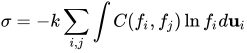
where the function C() represents binary collisions. At equilibrium, .

H-function
Boltzmann's H-function is defined by (Eq. 5.66 Ref. 3):

where is the molecular velocity. A restatement of the H-theorem is


See also
References
- L. Boltzmann "", Wiener Ber. 63 pp. 275- (1872)
- Sybren R. De Groot and Peter Mazur "Non-Equilibrium Thermodynamics", Dover Publications
- Robert Zwanzig "Nonequilibrium Statistical Mechanics", Oxford University Press (2001)