Order parameters: Difference between revisions
Carl McBride (talk | contribs) No edit summary |
Carl McBride (talk | contribs) mNo edit summary |
||
| Line 1: | Line 1: | ||
==Liquid crystals== | |||
The '''uniaxial order parameter''' is zero for an isotropic fluid and one for | The '''uniaxial order parameter''' is zero for an isotropic fluid and one for | ||
a perfectly aligned system. | a perfectly aligned system. | ||
| Line 37: | Line 38: | ||
indicate an ensemble average. | indicate an ensemble average. | ||
==See also== | |||
*[[Landau theory of second-order phase transitions]] | |||
==References== | ==References== | ||
#[http://dx.doi.org/10.1103/PhysRevA.10.1881 Joseph P. Straley "Ordered phases of a liquid of biaxial particles", Physical Review A '''10''' pp. 1881 - 1887 (1974)] | #[http://dx.doi.org/10.1103/PhysRevA.10.1881 Joseph P. Straley "Ordered phases of a liquid of biaxial particles", Physical Review A '''10''' pp. 1881 - 1887 (1974)] | ||
Revision as of 13:21, 26 November 2007
Liquid crystals
The uniaxial order parameter is zero for an isotropic fluid and one for a perfectly aligned system. First one calculates a director vector (see Ref. 2)

where is a second rank tensor, is a unit vector along the molecular long axis, and is the Kronecker delta. Diagonalisation of this tensor gives three eigenvalues , Failed to parse (SVG (MathML can be enabled via browser plugin): Invalid response ("Math extension cannot connect to Restbase.") from server "https://wikimedia.org/api/rest_v1/":): {\displaystyle \lambda_0} and Failed to parse (SVG (MathML can be enabled via browser plugin): Invalid response ("Math extension cannot connect to Restbase.") from server "https://wikimedia.org/api/rest_v1/":): {\displaystyle \lambda_-} , and Failed to parse (SVG (MathML can be enabled via browser plugin): Invalid response ("Math extension cannot connect to Restbase.") from server "https://wikimedia.org/api/rest_v1/":): {\displaystyle n} is the eigenvector associated with the largest eigenvalue (Failed to parse (SVG (MathML can be enabled via browser plugin): Invalid response ("Math extension cannot connect to Restbase.") from server "https://wikimedia.org/api/rest_v1/":): {\displaystyle \lambda_+} ). From this director vector the nematic order parameter is calculated from (Ref. 5)


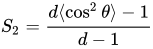
where d is the dimensionality of the system.
i.e. in three dimensions (see Ref. 3)
- Failed to parse (SVG (MathML can be enabled via browser plugin): Invalid response ("Math extension cannot connect to Restbase.") from server "https://wikimedia.org/api/rest_v1/":): {\displaystyle S_2 = \lambda _{+}= \langle P_2( n \cdot e)\rangle = \langle P_2(\cos\theta )\rangle =\langle \frac{3}{2} \cos^{2} \theta - \frac{1}{2} \rangle }
where Failed to parse (SVG (MathML can be enabled via browser plugin): Invalid response ("Math extension cannot connect to Restbase.") from server "https://wikimedia.org/api/rest_v1/":): {\displaystyle S_2} is known as the uniaxial order parameter. Here Failed to parse (SVG (MathML can be enabled via browser plugin): Invalid response ("Math extension cannot connect to Restbase.") from server "https://wikimedia.org/api/rest_v1/":): {\displaystyle P_2} is the second order Legendre polynomial, Failed to parse (SVG (MathML can be enabled via browser plugin): Invalid response ("Math extension cannot connect to Restbase.") from server "https://wikimedia.org/api/rest_v1/":): {\displaystyle \theta} is the angle between a molecular axes and the director , and the angle brackets indicate an ensemble average.

See also
References
- Joseph P. Straley "Ordered phases of a liquid of biaxial particles", Physical Review A 10 pp. 1881 - 1887 (1974)
- R. Eppenga and D. Frenkel "Monte Carlo study of the isotropic and nematic phases of infinitely thin hard platelets", Molecular Physics 52 pp. 1303-1334 (1984)
- Mark R. Wilson "Determination of order parameters in realistic atom-based models of liquid crystal systems", Journal of Molecular Liquids 68 pp. 23-31 (1996)
- Denis Merlet, James W. Emsley, Philippe Lesot and Jacques Courtieu "The relationship between molecular symmetry and second-rank orientational order parameters for molecules in chiral liquid crystalline solvents", Journal of Chemical Physics 111 pp. 6890-6896 (1999)
- Anna A. Mercurieva, Tatyana M. Birshtein "Liquid-crystalline ordering in two-dimensional systems with discrete symmetry", Die Makromolekulare Chemie, Theory and Simulations 1 pp. 205 - 214 (1992)