Substantive derivative: Difference between revisions
(new page. Some names) |
(Formulas added) |
||
| Line 1: | Line 1: | ||
The '''substantive derivative''' is a derivative taken along a path moving with velocity v, and is often used in fluid mechanics and classical mechanics. It describes the time rate of change of some quantity (such as heat or momentum) by following it, while moving with a – space and time dependent – velocity field. | |||
The material derivative of a scalar field <math>\phi( x, t )</math> is: | |||
:<math> \frac{D\varphi}{Dt} = \frac{\partial \varphi}{\partial t} + \mathbf{v}\cdot\nabla \varphi, | |||
</math> | |||
where <math> \nabla \varphi</math> is the gradient of the scalar. | |||
For a vector field <math>u( x, t )</math> it is defined as: | |||
:<math> \frac{D\mathbf{u}}{Dt} = \frac{\partial \mathbf{u}}{\partial t} + \mathbf{v}\cdot\nabla \mathbf{u}, | |||
</math> | |||
where <math>\nabla \mathbf{u}</math> is the covariant derivative of a vector. | |||
In case of the material derivative of a vector field, the term <math>\mathbf{v} \cdot \nabla \mathbf{u}</math> can both be interpreted as <math>\mathbf{v} \cdot (\nabla \mathbf{u})</math>, involving the tensor derivative of u, or as <math>(\mathbf{v} \cdot \nabla) \mathbf{u}</math>, leading to the same result.[7] | |||
==Names== | |||
There are many other names for this operator, including: | There are many other names for this operator, including: | ||
*'''material derivative''' | *'''material derivative''' | ||
| Line 11: | Line 27: | ||
*'''derivative following the motion''' | *'''derivative following the motion''' | ||
*'''total derivative''' | *'''total derivative''' | ||
==References== | |||
<references/> | |||
[[Category: classical mechanics]] | |||
Revision as of 13:12, 19 May 2010
The substantive derivative is a derivative taken along a path moving with velocity v, and is often used in fluid mechanics and classical mechanics. It describes the time rate of change of some quantity (such as heat or momentum) by following it, while moving with a – space and time dependent – velocity field.
The material derivative of a scalar field Failed to parse (SVG (MathML can be enabled via browser plugin): Invalid response ("Math extension cannot connect to Restbase.") from server "https://wikimedia.org/api/rest_v1/":): {\displaystyle \phi( x, t )} is:
- Failed to parse (SVG (MathML can be enabled via browser plugin): Invalid response ("Math extension cannot connect to Restbase.") from server "https://wikimedia.org/api/rest_v1/":): {\displaystyle \frac{D\varphi}{Dt} = \frac{\partial \varphi}{\partial t} + \mathbf{v}\cdot\nabla \varphi, }
where Failed to parse (SVG (MathML can be enabled via browser plugin): Invalid response ("Math extension cannot connect to Restbase.") from server "https://wikimedia.org/api/rest_v1/":): {\displaystyle \nabla \varphi} is the gradient of the scalar.
For a vector field Failed to parse (SVG (MathML can be enabled via browser plugin): Invalid response ("Math extension cannot connect to Restbase.") from server "https://wikimedia.org/api/rest_v1/":): {\displaystyle u( x, t )}
it is defined as:
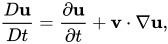
where Failed to parse (SVG (MathML can be enabled via browser plugin): Invalid response ("Math extension cannot connect to Restbase.") from server "https://wikimedia.org/api/rest_v1/":): {\displaystyle \nabla \mathbf{u}} is the covariant derivative of a vector.
In case of the material derivative of a vector field, the term Failed to parse (SVG (MathML can be enabled via browser plugin): Invalid response ("Math extension cannot connect to Restbase.") from server "https://wikimedia.org/api/rest_v1/":): {\displaystyle \mathbf{v} \cdot \nabla \mathbf{u}} can both be interpreted as Failed to parse (SVG (MathML can be enabled via browser plugin): Invalid response ("Math extension cannot connect to Restbase.") from server "https://wikimedia.org/api/rest_v1/":): {\displaystyle \mathbf{v} \cdot (\nabla \mathbf{u})} , involving the tensor derivative of u, or as Failed to parse (SVG (MathML can be enabled via browser plugin): Invalid response ("Math extension cannot connect to Restbase.") from server "https://wikimedia.org/api/rest_v1/":): {\displaystyle (\mathbf{v} \cdot \nabla) \mathbf{u}} , leading to the same result.[7]
Names
There are many other names for this operator, including:
- material derivative
- convective derivative
- advective derivative
- substantive derivative
- substantial derivative
- Lagrangian derivative
- Stokes derivative
- particle derivative
- hydrodynamic derivative
- derivative following the motion
- total derivative