Hard disk model: Difference between revisions
Jump to navigation
Jump to search
Carl McBride (talk | contribs) m (Hard disks moved to Hard disk model: Better title.) |
Carl McBride (talk | contribs) m (→Phase transitions: Added a recent publication) |
||
| Line 10: | Line 10: | ||
where <math> \Phi_{12}\left(r \right) </math> is the [[intermolecular pair potential]] between two disks at a distance <math>r := |\mathbf{r}_1 - \mathbf{r}_2|</math>, and <math> \sigma </math> is the diameter of the disk. This page treats hard disks in a two-dimensional space, for three dimensions see the page [[hard disks in a three dimensional space]]. | where <math> \Phi_{12}\left(r \right) </math> is the [[intermolecular pair potential]] between two disks at a distance <math>r := |\mathbf{r}_1 - \mathbf{r}_2|</math>, and <math> \sigma </math> is the diameter of the disk. This page treats hard disks in a two-dimensional space, for three dimensions see the page [[hard disks in a three dimensional space]]. | ||
==Phase transitions== | ==Phase transitions== | ||
Despite the apparent simplicity of this model/system, the phase behaviour and the nature of the phase transitions remains an area of active study. In a recent publication by Mak <ref>[http://dx.doi.org/10.1103/PhysRevE.73.065104 C. H. Mak "Large-scale simulations of the two-dimensional melting of hard disks", Physical Review E '''73''' 065104(R) (2006)]</ref> using over 4 million particles <math>(2048^2)</math> one appears to have the phase diagram isotropic <math>(\rho \leq 0.890)</math> hexatic <math>(\rho > 0.920)</math> solid. | Despite the apparent simplicity of this model/system, the phase behaviour and the nature of the phase transitions remains an area of active study. In a recent publication by Mak <ref>[http://dx.doi.org/10.1103/PhysRevE.73.065104 C. H. Mak "Large-scale simulations of the two-dimensional melting of hard disks", Physical Review E '''73''' 065104(R) (2006)]</ref> using over 4 million particles <math>(2048^2)</math> one appears to have the phase diagram isotropic <math>(\rho \leq 0.890)</math> hexatic <math>(\rho > 0.920)</math> solid. Similar results have been found using the [[BBGKY hierarchy]] <ref>[http://dx.doi.org/10.1063/1.3491039 Jarosław Piasecki, Piotr Szymczak, and John J. Kozak "Prediction of a structural transition in the hard disk fluid", Journal of Chemical Physics '''133''' 164507 (2010)]</ref>. | ||
==Equations of state== | ==Equations of state== | ||
:''Main article: [[Equations of state for hard disks]]'' | :''Main article: [[Equations of state for hard disks]]'' | ||
Revision as of 12:00, 26 October 2010
Hard disks are hard spheres in two dimensions. The hard disk intermolecular pair potential is given by[1] [2]
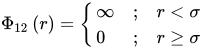
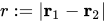
where is the intermolecular pair potential between two disks at a distance , and is the diameter of the disk. This page treats hard disks in a two-dimensional space, for three dimensions see the page hard disks in a three dimensional space.


Phase transitions
Despite the apparent simplicity of this model/system, the phase behaviour and the nature of the phase transitions remains an area of active study. In a recent publication by Mak [3] using over 4 million particles one appears to have the phase diagram isotropic hexatic solid. Similar results have been found using the BBGKY hierarchy [4].


Equations of state
- Main article: Equations of state for hard disks
Virial coefficients
- Main article: Hard sphere: virial coefficients
References
- ↑ Nicholas Metropolis, Arianna W. Rosenbluth, Marshall N. Rosenbluth, Augusta H. Teller and Edward Teller, "Equation of State Calculations by Fast Computing Machines", Journal of Chemical Physics 21 pp.1087-1092 (1953)
- ↑ W. W. Wood "Monte Carlo calculations of the equation of state of systems of 12 and 48 hard circles", Los Alamos Scientific Laboratory Report LA-2827 (1963)
- ↑ C. H. Mak "Large-scale simulations of the two-dimensional melting of hard disks", Physical Review E 73 065104(R) (2006)
- ↑ Jarosław Piasecki, Piotr Szymczak, and John J. Kozak "Prediction of a structural transition in the hard disk fluid", Journal of Chemical Physics 133 164507 (2010)
Related reading
- Ya G Sinai "Dynamical systems with elastic reflections", Russian Mathematical Surveys 25 pp. 137-189 (1970)
- Katherine J. Strandburg, John A. Zollweg, and G. V. Chester "Bond-angular order in two-dimensional Lennard-Jones and hard-disk systems", Physical Review B 30 pp. 2755 - 2759 (1984)
- Nándor Simányi "Proof of the Boltzmann-Sinai ergodic hypothesis for typical hard disk systems", Inventiones Mathematicae 154 pp. 123-178 (2003)
External links
- Hard disks and spheres computer code on SMAC-wiki.