Ideal gas: Energy: Difference between revisions
Jump to navigation
Jump to search
Carl McBride (talk | contribs) (New page: The energy of the ideal gas is given by (Hill Eq. 4-16) :<math>E = kT^2 \left. \frac{\partial \ln Q}{\partial T} \right\vert_{V,N}= NkT^2 \frac{d \ln T^{3/2}}{dT} = \frac{3}{2} NkT</m...) |
(Expression for more degrees of freedom) |
||
| (3 intermediate revisions by 2 users not shown) | |||
| Line 1: | Line 1: | ||
The energy of the [[ideal gas]] is given by (Hill Eq. 4-16) | The energy of the [[ideal gas]] is given by (Hill Eq. 4-16) | ||
:<math>E = kT^2 \left. \frac{\partial \ln Q}{\partial T} \right\vert_{V,N}= NkT^2 \frac{d \ln T^{3/2}}{dT} = \frac{3}{2} NkT</math> | :<math>E = -T^2 \left. \frac{\partial (A/T)}{\partial T} \right\vert_{V,N} = kT^2 \left. \frac{\partial \ln Q}{\partial T} \right\vert_{V,N}= NkT^2 \frac{d \ln T^{3/2}}{dT} = \frac{3}{2} NkT \equiv \frac{3}{2} RT </math> | ||
where <math>R</math> is the [[molar gas constant]]. | |||
This energy is all ''kinetic energy'', <math>1/2 kT</math> per [[degree of freedom]], by [[equipartition]]. This is because there are no intermolecular forces, thus no potential energy. This result is valid only for a monoatomic ideal gas. The general expression would be | |||
:<math>E = \frac{n}{2} NkT = \frac{n}{2} RT, </math> | |||
where <math>n</math> is the number of degrees of freedom. This number is 3 for atoms; if would be 6 in principle for diatomic molecules, but in normal conditions 5 is a very good approximation since vibrations are "frozen" (as explained in the entry about [[degree of freedom | degrees of freedom]].) | |||
==References== | ==References== | ||
#Terrell L. Hill "An Introduction to Statistical Thermodynamics" 2nd Ed. Dover (1962) | #Terrell L. Hill "An Introduction to Statistical Thermodynamics" 2nd Ed. Dover (1962) | ||
[[category: ideal gas]] | [[category: ideal gas]] | ||
Latest revision as of 16:44, 12 December 2008
The energy of the ideal gas is given by (Hill Eq. 4-16)

where is the molar gas constant. This energy is all kinetic energy, per degree of freedom, by equipartition. This is because there are no intermolecular forces, thus no potential energy. This result is valid only for a monoatomic ideal gas. The general expression would be


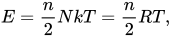
where is the number of degrees of freedom. This number is 3 for atoms; if would be 6 in principle for diatomic molecules, but in normal conditions 5 is a very good approximation since vibrations are "frozen" (as explained in the entry about degrees of freedom.)

References[edit]
- Terrell L. Hill "An Introduction to Statistical Thermodynamics" 2nd Ed. Dover (1962)