Generalized exponential model: Difference between revisions
Jump to navigation
Jump to search
Carl McBride (talk | contribs) m (Added a little more...) |
Carl McBride (talk | contribs) m (Added recent publications) |
||
| Line 1: | Line 1: | ||
The '''Generalized exponential model''' (or '''GEM-m''' potential) is given by (Eq. x in <ref> | The '''Generalized exponential model''' (or '''GEM-m''' potential) is given by (Eq. x in <ref>unknown</ref>): | ||
:<math> \Phi_{12}(r) = \epsilon \exp \left[ -\left( \frac{r}{\sigma} \right)^m \right]</math> | :<math> \Phi_{12}(r) = \epsilon \exp \left[ -\left( \frac{r}{\sigma} \right)^m \right]</math> | ||
| Line 16: | Line 16: | ||
<references/> | <references/> | ||
;Related reading | ;Related reading | ||
*[https://doi.org/10.1063/1.5043546 Andreas Kvist Bacher, Thomas B. Schrøder, and Jeppe C. Dyre "The EXP pair-potential system. I. Fluid phase isotherms, isochores, and quasiuniversality", Journal of Chemical Physics '''149''' 114501 (2018)] | |||
*[https://doi.org/10.1063/1.5043548 Andreas Kvist Bacher, Thomas B. Schrøder, and Jeppe C. Dyre "The EXP pair-potential system. II. Fluid phase isomorphs", Journal of Chemical Physics '''149''' 114502 (2018)] | |||
[[category: models]] | [[category: models]] | ||
Latest revision as of 12:03, 25 September 2018
The Generalized exponential model (or GEM-m potential) is given by (Eq. x in [1]):
![{\displaystyle \Phi _{12}(r)=\epsilon \exp \left[-\left({\frac {r}{\sigma }}\right)^{m}\right]}](https://wikimedia.org/api/rest_v1/media/math/render/svg/398a7b3390b36654b53354a0f4533487e6865ecc)
where
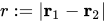
- is the intermolecular pair potential between two particles or sites

m=1[edit]
Also known as the EXP model [2].
m=4[edit]
2-dimensions [3].
See also[edit]
References[edit]
- ↑ unknown
- ↑ Andreas K. Bacher, Thomas B. Schrøder and Jeppe C. Dyre "Explaining why simple liquids are quasi-universal", Nature Communications 5 Article number 5424 (2014)
- ↑ Santi Prestipino and Franz Saija "Hexatic phase and cluster crystals of two-dimensional GEM4 spheres", Journal of Chemical Physics 141 184502 (2014)
- Related reading
- Andreas Kvist Bacher, Thomas B. Schrøder, and Jeppe C. Dyre "The EXP pair-potential system. I. Fluid phase isotherms, isochores, and quasiuniversality", Journal of Chemical Physics 149 114501 (2018)
- Andreas Kvist Bacher, Thomas B. Schrøder, and Jeppe C. Dyre "The EXP pair-potential system. II. Fluid phase isomorphs", Journal of Chemical Physics 149 114502 (2018)