Normal matrices: Difference between revisions
(New page: A complex square matrix A is a normal matrix if :<math>A^\dagger A=AA^\dagger ,</math> where <math>A^\dagger</math> is the conjugate transpose of A. That is, a matrix is normal if it [[c...) |
mNo edit summary |
||
| (2 intermediate revisions by one other user not shown) | |||
| Line 13: | Line 13: | ||
==References== | ==References== | ||
*[http://en.wikipedia.org/wiki/ | *[http://en.wikipedia.org/wiki/Normal_matrix Normal matrix entry in Wikipedia] | ||
[[category: mathematics]] | |||
Latest revision as of 11:19, 11 February 2008
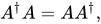
A complex square matrix A is a normal matrix if
where Failed to parse (SVG (MathML can be enabled via browser plugin): Invalid response ("Math extension cannot connect to Restbase.") from server "https://wikimedia.org/api/rest_v1/":): {\displaystyle A^\dagger} is the conjugate transpose of A. That is, a matrix is normal if it commutes with its conjugate transpose: Failed to parse (SVG (MathML can be enabled via browser plugin): Invalid response ("Math extension cannot connect to Restbase.") from server "https://wikimedia.org/api/rest_v1/":): {\displaystyle [A,A^\dagger]=0} .
Normal matrices are precisely those to which the spectral theorem applies: a matrix Failed to parse (SVG (MathML can be enabled via browser plugin): Invalid response ("Math extension cannot connect to Restbase.") from server "https://wikimedia.org/api/rest_v1/":): {\displaystyle A} is normal if and only if it can be represented by a diagonal matrix Failed to parse (SVG (MathML can be enabled via browser plugin): Invalid response ("Math extension cannot connect to Restbase.") from server "https://wikimedia.org/api/rest_v1/":): {\displaystyle \Lambda} and a unitary matrix Failed to parse (SVG (MathML can be enabled via browser plugin): Invalid response ("Math extension cannot connect to Restbase.") from server "https://wikimedia.org/api/rest_v1/":): {\displaystyle U} by the formula
where
- Failed to parse (SVG (MathML can be enabled via browser plugin): Invalid response ("Math extension cannot connect to Restbase.") from server "https://wikimedia.org/api/rest_v1/":): {\displaystyle \Lambda = \mathrm{diag} (\lambda_1, \lambda_2, \dots)}
- Failed to parse (SVG (MathML can be enabled via browser plugin): Invalid response ("Math extension cannot connect to Restbase.") from server "https://wikimedia.org/api/rest_v1/":): {\displaystyle U^\dagger U = U U^\dagger= I.}
The entries Failed to parse (SVG (MathML can be enabled via browser plugin): Invalid response ("Math extension cannot connect to Restbase.") from server "https://wikimedia.org/api/rest_v1/":): {\displaystyle \lambda_i} of the diagonal matrix Failed to parse (SVG (MathML can be enabled via browser plugin): Invalid response ("Math extension cannot connect to Restbase.") from server "https://wikimedia.org/api/rest_v1/":): {\displaystyle \Lambda} are the eigenvalues of , and the columns of Failed to parse (SVG (MathML can be enabled via browser plugin): Invalid response ("Math extension cannot connect to Restbase.") from server "https://wikimedia.org/api/rest_v1/":): {\displaystyle U} are the eigenvectors of Failed to parse (SVG (MathML can be enabled via browser plugin): Invalid response ("Math extension cannot connect to Restbase.") from server "https://wikimedia.org/api/rest_v1/":): {\displaystyle A} . The matching eigenvalues in Failed to parse (SVG (MathML can be enabled via browser plugin): Invalid response ("Math extension cannot connect to Restbase.") from server "https://wikimedia.org/api/rest_v1/":): {\displaystyle \Lambda} must be ordered as the eigenvectors are ordered as columns of Failed to parse (SVG (MathML can be enabled via browser plugin): Invalid response ("Math extension cannot connect to Restbase.") from server "https://wikimedia.org/api/rest_v1/":): {\displaystyle U} .

