Heaviside step distribution: Difference between revisions

From SklogWiki
Jump to navigation Jump to search
No edit summary
m (Reverted edits by 89.20.145.223 (Talk); changed back to last version by Carl McBride)
 
(3 intermediate revisions by 2 users not shown)
Line 9: Line 9:
\end{array} \right.
\end{array} \right.
</math>
</math>
Note that other definitions exist at <math>H(0)</math>, for example <math>H(0)=1</math>.
In the famous [http://www.wolfram.com/products/mathematica/index.html Mathematica] computer
package  <math>H(0)</math> is unevaluated.
==Applications==
*[[Fourier analysis]]
==Differentiating the Heaviside  distribution==
At first glance things are hopeless:
Line 26: Line 33:
:<math>\frac{{\rm d}}{{\rm d}x} H_{\epsilon}(x-a)= \frac{1}{\epsilon}\left( H(x - (a-\frac{\epsilon}{2})) - H (x - (a+\frac{\epsilon}{2}))\right)</math>  


in the limit this is the [[Dirac delta function]]. Thus  
in the limit this is the [[Dirac delta distribution]]. Thus  
 
:<math>\frac{{\rm d}}{{\rm d}x} [H(x)]= \delta(x)</math>
 
The delta function has the fundamental property that
 
:<math>\int_{-\infty}^{\infty} f(x) \delta(x-a) {\rm d}x = f(a)</math>


:<math>\frac{{\rm d}}{{\rm d}x} [H(x)]= \delta(x)</math>.
==References==
==References==
#[http://store.doverpublications.com/0486612724.html  Milton Abramowitz and  Irene A. Stegun "Handbook of Mathematical Functions" Dover Publications ninth printing.]  
[[category:mathematics]]
[[category:mathematics]]

Latest revision as of 12:12, 5 July 2007

The Heaviside step distribution is defined by (Abramowitz and Stegun Eq. 29.1.3, p. 1020):
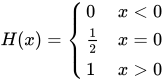
Failed to parse (SVG (MathML can be enabled via browser plugin): Invalid response ("Math extension cannot connect to Restbase.") from server "https://wikimedia.org/api/rest_v1/":): {\displaystyle H(x) = \left\{ \begin{array}{ll} 0 & x < 0 \\ \frac{1}{2} & x=0\\ 1 & x > 0 \end{array} \right. }

Note that other definitions exist at Failed to parse (SVG (MathML can be enabled via browser plugin): Invalid response ("Math extension cannot connect to Restbase.") from server "https://wikimedia.org/api/rest_v1/":): {\displaystyle H(0)} , for example Failed to parse (SVG (MathML can be enabled via browser plugin): Invalid response ("Math extension cannot connect to Restbase.") from server "https://wikimedia.org/api/rest_v1/":): {\displaystyle H(0)=1} . In the famous Mathematica computer package Failed to parse (SVG (MathML can be enabled via browser plugin): Invalid response ("Math extension cannot connect to Restbase.") from server "https://wikimedia.org/api/rest_v1/":): {\displaystyle H(0)} is unevaluated.

Applications[edit]

Differentiating the Heaviside distribution[edit]

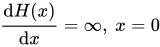
At first glance things are hopeless:
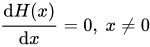
Failed to parse (SVG (MathML can be enabled via browser plugin): Invalid response ("Math extension cannot connect to Restbase.") from server "https://wikimedia.org/api/rest_v1/":): {\displaystyle \frac{{\rm d}H(x)}{{\rm d}x}= 0, ~x \neq 0}
Failed to parse (SVG (MathML can be enabled via browser plugin): Invalid response ("Math extension cannot connect to Restbase.") from server "https://wikimedia.org/api/rest_v1/":): {\displaystyle \frac{{\rm d}H(x)}{{\rm d}x}= \infty, ~x = 0}

however, lets define a less brutal jump in the form of a linear slope such that

Failed to parse (SVG (MathML can be enabled via browser plugin): Invalid response ("Math extension cannot connect to Restbase.") from server "https://wikimedia.org/api/rest_v1/":): {\displaystyle H_{\epsilon}(x-a)= \frac{1}{\epsilon}\left( R(x - (a-\frac{\epsilon}{2})) - R (x - (a+\frac{\epsilon}{2}))\right)}

in the limit Failed to parse (SVG (MathML can be enabled via browser plugin): Invalid response ("Math extension cannot connect to Restbase.") from server "https://wikimedia.org/api/rest_v1/":): {\displaystyle \epsilon \rightarrow 0} this becomes the Heaviside function Failed to parse (SVG (MathML can be enabled via browser plugin): Invalid response ("Math extension cannot connect to Restbase.") from server "https://wikimedia.org/api/rest_v1/":): {\displaystyle H(x-a)} . However, lets differentiate first:

Failed to parse (SVG (MathML can be enabled via browser plugin): Invalid response ("Math extension cannot connect to Restbase.") from server "https://wikimedia.org/api/rest_v1/":): {\displaystyle \frac{{\rm d}}{{\rm d}x} H_{\epsilon}(x-a)= \frac{1}{\epsilon}\left( H(x - (a-\frac{\epsilon}{2})) - H (x - (a+\frac{\epsilon}{2}))\right)}

in the limit this is the Dirac delta distribution. Thus

Failed to parse (SVG (MathML can be enabled via browser plugin): Invalid response ("Math extension cannot connect to Restbase.") from server "https://wikimedia.org/api/rest_v1/":): {\displaystyle \frac{{\rm d}}{{\rm d}x} [H(x)]= \delta(x)} .

References[edit]

  1. Milton Abramowitz and Irene A. Stegun "Handbook of Mathematical Functions" Dover Publications ninth printing.